The Singing Piano Background
The Singing Piano is the result of a lifetime devoted to music, learning, performance, and teaching. It grew from a desire to share what I have discovered over decades as a pianist and educator, so that others may benefit from the knowledge, insights, and experiences that have shaped my own musical journey.
Years ago, my Humanities professor—Roger Blakely, a close friend of my piano instructor, Donald Betts, Macalester College—suggested that I write a piano method. Decades later, I find myself doing just that. The Singing Piano is the culmination of years spent refining my teaching through private lessons, college piano labs, online instruction, group coaching, and thousands of hours spent observing how people learn.
Over time, I became increasingly interested in helping adults reclaim and expand their musical abilities. I wanted to create a program that would develop not only piano skills, but also musicianship, artistry, creativity, and a deeper understanding of how music works. Most importantly, I wanted to provide a clear path forward for adults seeking greater confidence, fluency, and personal expression at the piano.
Throughout my years of teaching and performing, I discovered that people learn most effectively when they engage multiple senses and ways of thinking. This realization became the foundation of The Singing Piano's Mind–Body–Heart Approach.
Students learn to see, hear, feel, understand, and express music. They learn to examine rhythm, melody, harmony, movement, and musical structure both separately and together. They discover how music looks on the page, feels in the body, sounds to the ear, and functions as a complete artistic language.
Over time, this multisensory approach becomes increasingly natural. Playing grows more fluent, understanding deepens, confidence expands, and artistry begins to emerge as each student discovers their own unique voice at the piano.
My Background
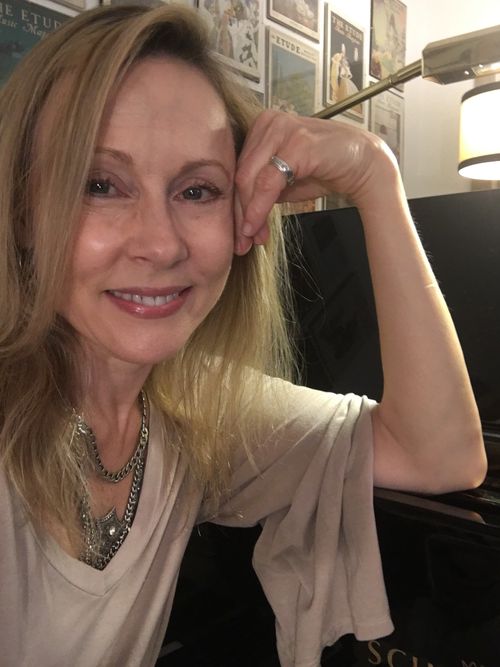
Tracy Loftsgaarden is a pianist, performer, and educator with five decades of experience studying, performing, and teaching piano.
She earned a Bachelor of Arts degree in Piano Performance from Macalester College and a Master of Music degree in Piano Performance and Piano Pedagogy from Bowling Green State University, where she served as a graduate teaching assistant in class piano on a full scholarship.
Throughout her career, Tracy has taught more than one thousand students through private instruction, college piano labs, group classes, workshops, and online coaching. Her teaching and accompanying experiences includes positions at Bowling Green State University, Century Community College, Oral Roberts University, and Arizona State University and at the Zach Theater in Austin, TX.
As a performer, she has appeared as a concerto soloist with orchestras in Minnesota, Ohio, Arizona, and Texas, and has performed concerts and recitals throughout the United States and abroad.
In addition to her teaching and performing work, Tracy has served as President of the St. Paul Piano Teachers Association, adjudicated piano competitions and examinations, and coached students for competitions, performances, and recitals.
Since 2016, Tracy has taught piano online, helping students around the United States develop confidence, fluency, artistry, and a lifelong love of music.
- Bachelor of Arts, Piano Performance, Macalester College (summa cum laude)
- Master of Music, Bowling Green State University
- Pi Kappa Lambda Honor Society
- Outstanding Graduate Teaching Assistant, Bowling Green State University
- Former President, St. Paul Piano Teachers Association
- College Piano Lab Instructor, BGSU, ORU, The Zach
- Concerto Soloist with Multiple Orchestras
- More than 1,000 Students Taught
- More than 50 Years of Teaching and Performance Experience
- Online Piano Instructor Since 2016
Why "The Singing Piano"?
The name The Singing Piano is a nod to several of my teachers, who taught me the importance of developing a singing tone at the piano—one that allows the melody to rise above the accompaniment and communicate with the expressive qualities of the human voice.
To make a piano sing requires more than playing the correct notes. It involves shaping each phrase with intention, listening deeply, and discovering how music can tell a meaningful story—with or without words.
The name is also a tribute to my parents, both beautiful singers who frequently burst into song at home, filling our family life with music, warmth, and joy.
In many ways, The Singing Piano reflects both of these influences: the pursuit of artistic expression and the belief that music is meant to be shared.

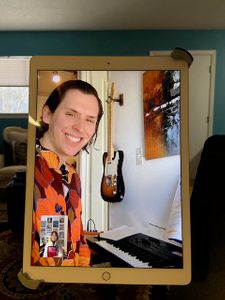
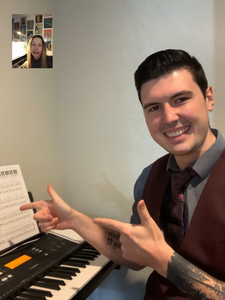
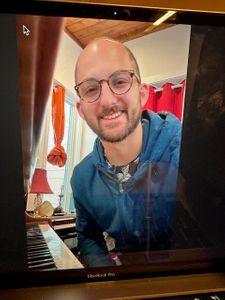

Students pictured during their online Classes
From left to right, Jordan, Leo and Reno.
During a Zoom Classes, students have the option of using their phone, ipad, laptop, or even a desktop computer. Whatever device you use, the best angle for viewing students during class is to have the screen off to the side so you, your keyboard and your hands are within view. I position my screen in the same way so you can see the technique in my demonstrations. I also use an overhead camera for playing demonstrations of scales and chords on the keys.
An iPad or laptop may be best for you if you prefer seeing instruction on a bigger screen, but a phone can also work.